Investing

investing basics
Investing is one way people try to grow their money over time. Instead of simply saving money in a bank account, investing involves purchasing assets that may increase in value in the future.
Many individuals invest to help reach long-term financial goals, such as:
Buying a home
Starting a business
Preparing for retirement
Unlike savings accounts, investments can go up or down in value, which means there is always some level of risk involved. Because of this, learning the basics of investing can help you better understand how financial markets work and how people make decisions about their money.
savings vs investing
Savings and investing both play important roles in personal finance, but they serve different purposes. It’s crucial to understand the difference.
Savings usually involve keeping money in a safe and easily accessible place. Common characteristics of saving include…
Money is often kept in a savings account
Lower risk of losing value
Easy access to funds
Often used for short-term goals or emergencies
Investing involves putting your money into assets that may grow in value over time. Common characteristics of investing include…
Money is placed into financial assets (stocks, bonds, etc.)
Potential for higher returns
Value can rise or fall, depending on the market
Often used for long-term goals
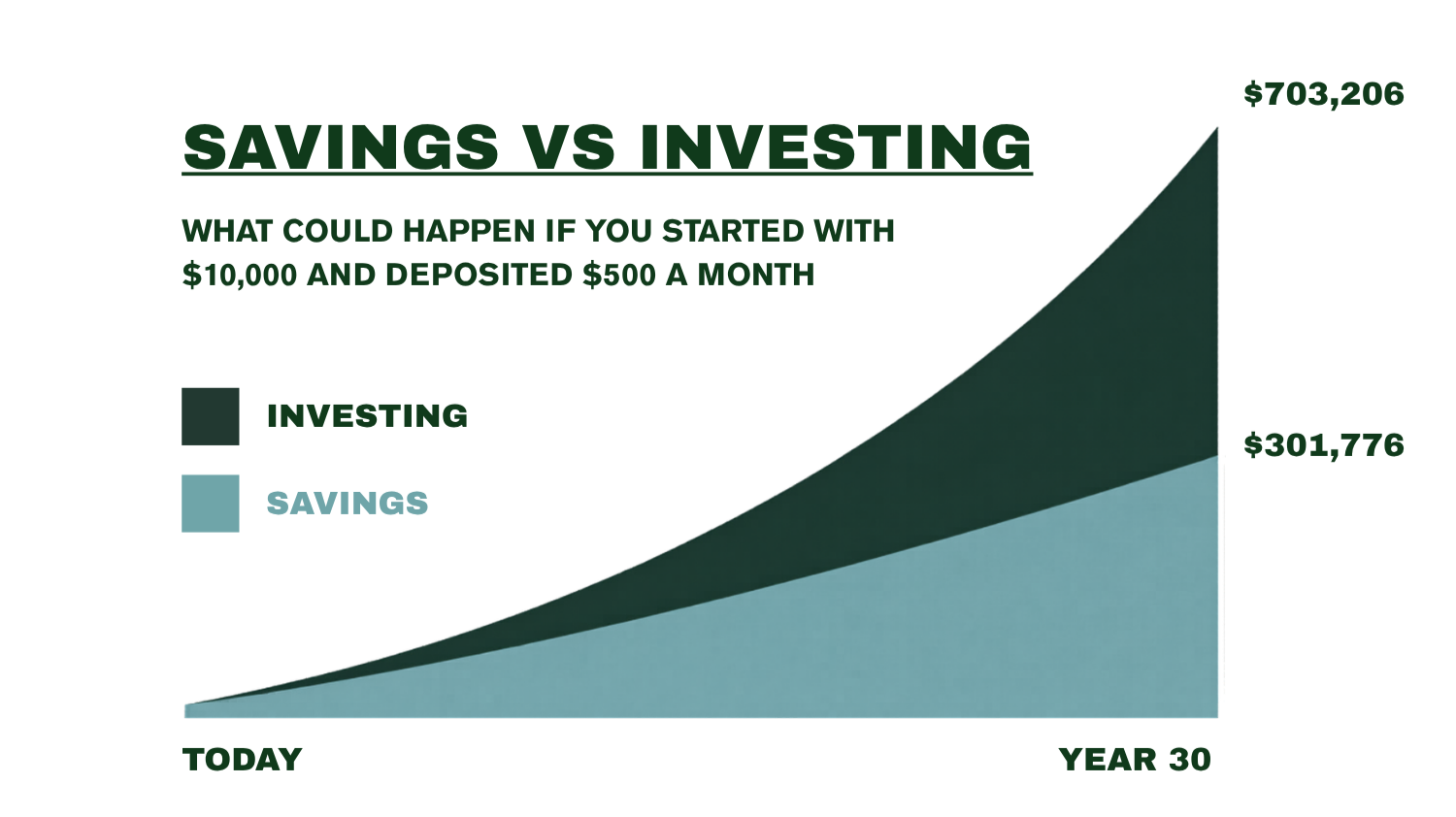
Here is a good representation of how savings and investments work over time:
Note: Many people use both saving and investing as part of their overall financial strategy!
Basics of the stock market
What is the Stock Market?
The stock market is a place where people can buy and sell ownership in companies. It allows businesses to raise money and gives individuals the opportunity to participate in the growth of those businesses.
Understanding the basics of the stock market is an important part of financial literacy.
What is a security?
Securities are financial instruments that are used to raise capital in public or private markets. People will also call securities investments, instruments, or holdings. They represent financial value, such as stocks (equity) or bonds (debt).
What Is a Stock?
A stock represents ownership in a company.
When a company offers stock to the public, individuals can purchase small pieces of that company called shares.
Examples of well-known companies that are publicly traded include:
Apple
Nike
Amazon
Note: The value of a stock can change over time based on factors such as company performance, economic conditions, and investor demand.
Stock Exchanges
Stocks are bought and sold on stock exchanges, which are organized marketplaces where investors trade shares.
Major examples include:
NYSE (New York Stock Exchange)
One of the largest stock exchanges in the world
Located in New York City
Trades many well-known, established companies
Example companies: large corporations (banks, major retailers, global brands)
NASDAQ (National Association of Securities Dealers Automated Quotations)
Based in the United States
Known for technology companies
Many modern and fast-growing companies trade here
https://www.fidelity.com/learning-center/smart-money/what-is-nasdaq
Owning a Share
When someone buys a share of stock, they:
Become a partial owner of the company
May benefit if the company’s value increases
Take on the responsibility that the value could decrease
Owning a stock does not mean managing the company. Instead it represents a financial interest in the business.
Dividends
Some companies may also pay dividends, which are payments made to shareholders from company profits. You can think of it as a little thank-you-gift from the company for investing in them.
How the Stock Market Works
Primary Market
The primary market is where securities are created and sold for the first time.
When a company decides to sell shares of stock to the public for the first time, it does so through an Initial Public Offering (IPO). In this process, investors purchase shares directly from the company.
Key points:
Securities are sold for the first time
Companies raise money from investors
Initial Public Offerings (IPOs) occur here
After these shares are first sold, they begin trading in the secondary market.
Secondary Market
The secondary market is where investors buy and sell securities from each other after the initial sale. Stock exchanges like the New York Stock Exchange (NYSE) and NASDAQ operate within the secondary market.
NOTE: This is the market most people refer to when they talk about the stock market.
Key points:
Investors trade securities with other investors
Companies do not receive money from these transactions
Most stock trading happens here
Broker-Dealers
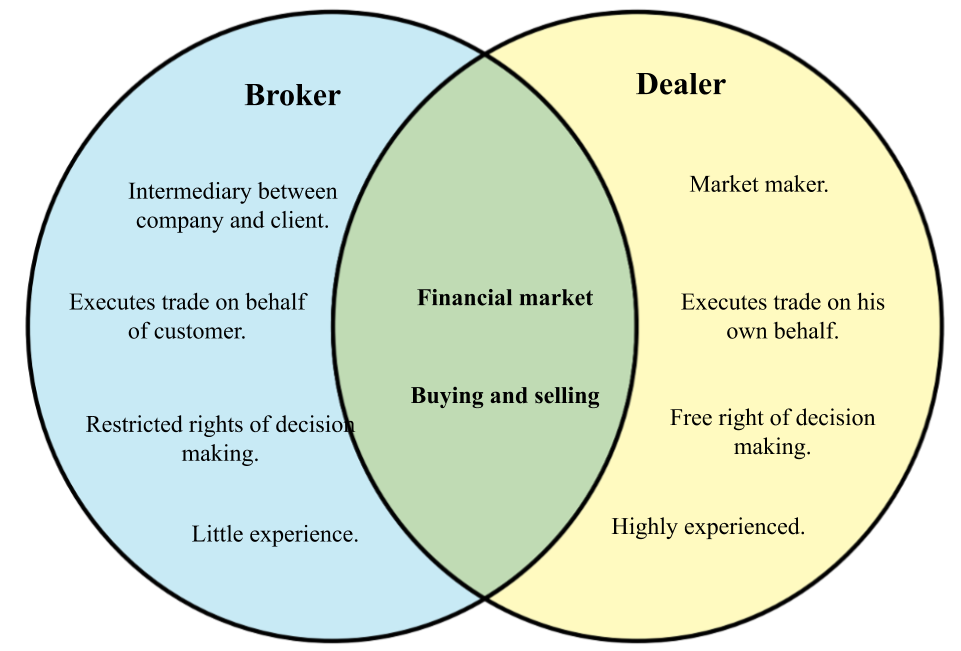
A broker-dealer is a financial professional or firm that helps investors buy and sell securities. Broker-dealers act as intermediaries between buyers and sellers in financial markets. Examples of broker-dealer firms include:
Fidelity
Charles Schwab
Robinhood
These firms provide platforms that allow individuals to access financial markets and execute trades.
Over-the-Counter (OTC) Markets
Not all securities trade on large stock exchanges. Some are traded over-the-counter (OTC).
Over-the-counter markets involve trading securities directly between parties through networks of broker-dealers instead of through centralized exchanges.
Characteristics of OTC markets:
Trades occur directly between participants
Often used for bonds and smaller company stocks
Transactions are facilitated by broker-dealers
Common Types of Investments
Stocks
A stock represents partial ownership in a public company.
The value of a stock can rise or fall
Potential for capital appreciation (price increases)
Some companies pay dividends
Higher growth potential, but also higher risk
Bonds
A bond is a loan made by an investor to a government or company that needs principal (aka money). It is generally paid back with interest.
Investors lend money to the issuer
The original amount is repaid at maturity (a specific calendar day) plus interest
Bonds represent lending rather than ownership
Bonds are often traded over-the-counter (OTC) between broker-dealers rather than on centralized exchanges
Government bonds (such as treasury bills, notes, bonds, TIPS) are very safe. The government never defaults on loans, so they’ll always pay you back
Index Funds and ETFs
Index funds and Exchange-Traded Funds (ETFs) hold collections of investments within a single fund
Passively managed
Have lower fees than mutual funds
Offers diversification
These contain multiple investments and provide diversification
Can include stocks, bonds, or both
Designed to follow a specific market index or strategy
Instead of investing in one company, investors gain exposure to many companies at once. For example, some funds track the S&P 500, which represents many large U.S. companies.
Mutual Funds
A mutual fund pools money from many investors to buy a diversified portfolio of stocks, bonds, or other assets. They’re managed by professional fund managers who make decisions about what to buy or sell.
Actively managed
Have higher fees than ETFs (there are management costs)
Offers diversification
Investors buy shares in the fund; the value of these shares rises or falls based on the performance of the fund’s assets.
Typically available to the general public through brokers or retirement accounts
Common Market Indexes
A market index is a tool that tracks the performance of a specific group of stocks, bonds, or other assets. It functions as a benchmark, allowing investors to measure market trends, analyze portfolio performance, and gauge economic health. The goal of index funds is to match the performance of a market index, rather than beat it.
S&P500
The S&P 500 is one of the most widely followed stock market indexes in the United States. It tracks the performance of 500 large publicly traded companies across many industries.
The S&P 500 is often used as a general indicator of how the U.S. stock market is performing. Many investment funds are designed to follow the performance of this index.
DJIA
The Dow Jones Industrial Average (DJIA) tracks 30 significant, large-cap “blue-chip” U.S. companies and is price-weighted, focusing on industrial trends.
Understanding Risk and Return
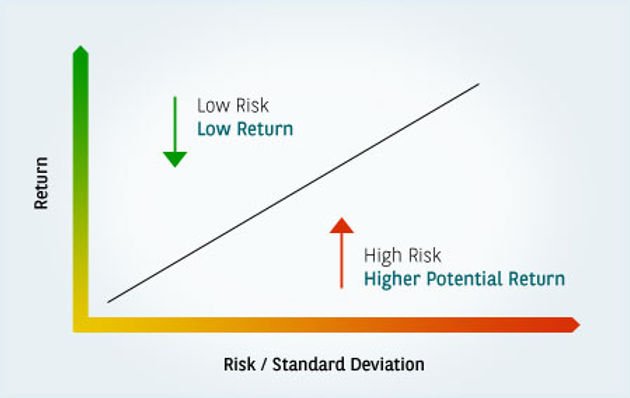
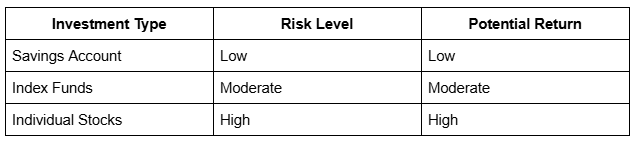
Risk and return are important concepts in investing. You will hear it a lot in the business world! Understanding this relationship helps explain why different investments behave differently over time.
Risk: the possibility that an investment could lose value
Return: the potential gain or profit from an investment
Examples:
In general:
Higher potential returns often comes with higher risk
Lower risk investments may have lower potential returns
Long-term investing reduces risk compared to short-term trading
Market values can change due to economic conditions, company performance, and investor behavior
Which is Riskier: Stocks or Bonds?
Stocks are generally considered riskier than bonds. Why?
Stocks:
Prices can change frequently
Investors may lose money if the stock price falls
Bonds:
Represent loans that must typically be repaid
Investors receive interest payments
Liquidity
Another important concept is liquidity. Liquidity refers to how quickly and easily an investment can be converted into cash without significantly affecting its price. Some investments are more liquid than others.
Examples:
Cash → very liquid
Stocks → generally liquid because they can often be sold quickly
Real estate → less liquid because selling property can take time
Understanding liquidity helps investors recognize how accessible their money may be.
Diversification
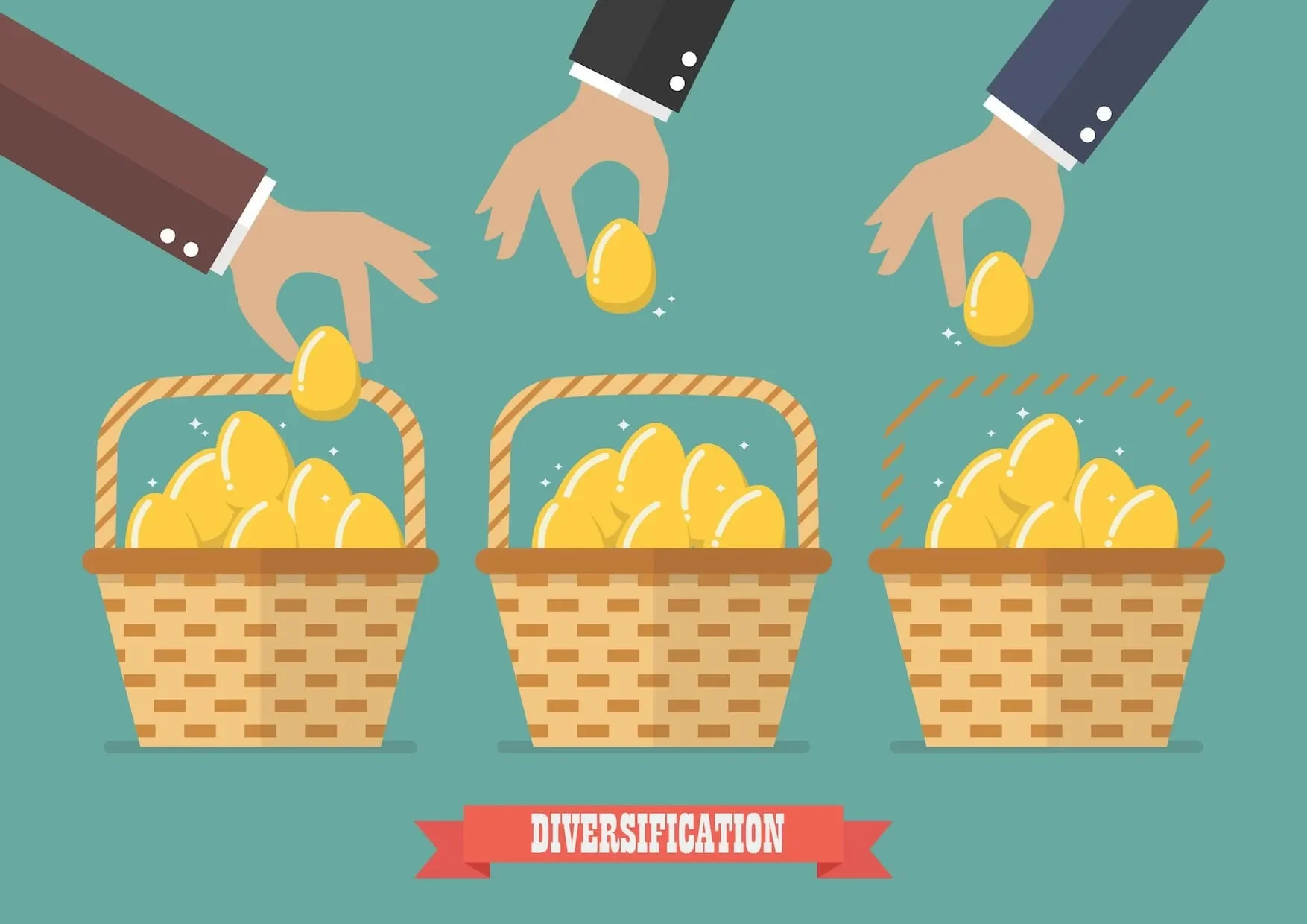
Diversification: the spreading of investments across multiple assets rather than relying on one single investment.
Another way to say this? “Don’t put all your eggs in one basket.”
Diversification may involve:
Investing in different companies (e.g., Apple, Nike)
Investing in multiple industries (e.g., automotive, energy)
Holding a variety of asset types (e.g., stocks, bonds)
Reducing risk if one company performs poorly
How Investing Builds Wealth
Why Starting Early Matters
One advantage to investing early is the ability to benefit from compound growth. Compound growth occurs when earnings generate additional earnings over time.
This means investment returns can grow on both:
The original investment
The returns that accumulate over time
Even small contributions may grow significantly over long periods.
How to Start Investing as a Student
You don’t need thousands of dollars. Many platforms allow investing with small amounts. There’s automatic investing as well.
Examples of beginner platforms:
Robinhood
Fidelity
Charles Schwab
Some platforms offer fractional shares, which allow investors to purchase part of a share instead of a full share. This means you can begin learning about investing with smaller amounts of money, such as $5-$20.
Quick Q&A: Stock Market Basics
❓ Do I need a lot of money to invest in stocks?
No. Some platforms allow individuals to start with small amounts of money and offer fractional shares.
❓ Is the stock market the same as gambling?
No. Investing involves ownership in companies and financial analysis, while gambling is based primarily on chance. However, investing still involves risk.
❓ How does someone buy a stock?
Stocks are typically purchased through brokerage accounts offered by financial institutions.
❓ How do people make money from stocks?
Two common ways include:
Stock prices increasing over time
Companies paying dividends to shareholders
❓ Why do companies sell stock?
Companies sell stock to raise money to grow their business, develop products, hire employees, or expand operations.
SOURCES
https://www.investopedia.com/investing/importance-diversification/

Disclaimer: This information is provided as an educational resource. College Money Mind does not receive compensation for recommendations and encourages students to research options before making financial decisions.